Showing posts with label Container Ships. Show all posts

Friday, 19 March 2010

Collision at Port of Constanta


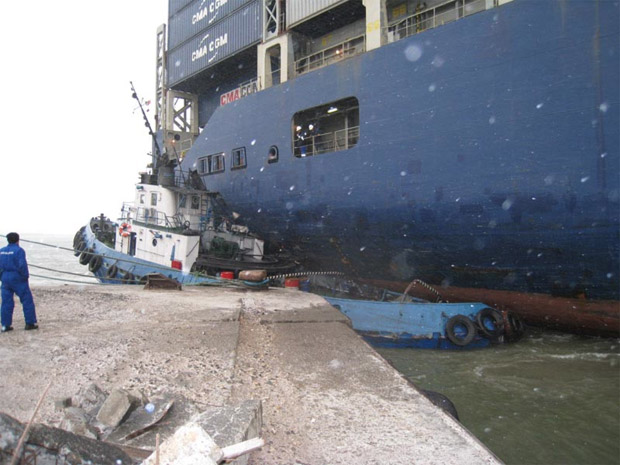
2010 vadeni 01 Incident Photo (and video) of The Week   Collision at Port of Constanta
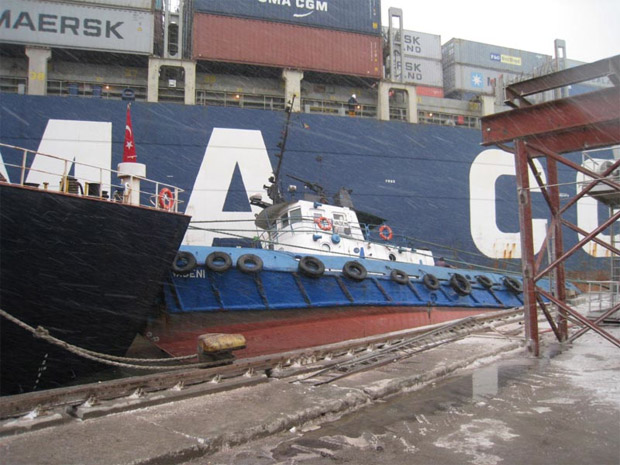
2010 vadeni 04 Incident Photo (and video) of The Week   Collision at Port of Constanta
This weeks incident photos and video is of the M/V CMA CGM Debussy pinning the tug Vadeni.  The incident occurred on March 8th at the Port of Constanta, Romania.  Cargo Law has some of the details:
73,157-gt French container M/V CMA CGM Debussy (IMO 9235907) struck the stern of Turkish cargo M/V Haci Fatma Sari (IMO 7600079) while maneuvering in the port of Constanta, Romania, and nearly sucked under the harbor tug Vadeni (IMO 7623423) which was caught between the vessels, causing considerable damage, on Mar. 8.

Tuesday, 9 March 2010

Science a step closer to biofuel for ships


I found this report on the Maersk website about Bio fuels.
Quite an interesting read.

Science a step closer to biofuel for ships

Slowly but surely, science seems to be advancing toward a production of biofuel that does not take away agricultural land from the world’s food supply. When this kind of fuel is ready, so is A.P. Moller - Maersk.

Five Maersk business units are already carrying out tests on a large container vessel with the ultimate aim of cutting CO2 emissions and diversifying the fuel supply. It is currently being tested how the fuel tanks and engines of Maersk Kalmar react to biodiesel, and this puts the Group at the forefront of the industry. The test is made with biodiesel based on crops grown in temperate regions, or reused oils. In the first go, the scope is a fuel blend with 5-7 % biodiesel.

The partners in the Biodiesel Project are Maersk Line, Maersk Tankers, Maersk Supply Service, Maersk Drilling, Maersk Ship Management, Lloyd’s Register – Strategic Research Group, and a consortium of Dutch subcontractors. The project is supported by the Dutch government.

Action could be relevant sooner than expected. Recently, several biotech companies have reported positive leaps in the creation of enzymes, which act as catalysts when biomass, such as agricultural waste, is converted into fuel. Jacob Sterling of the Maersk Line sustainability team considers the reports encouraging.

“It’s good news. Maersk Line will probably never sail on bioethanol, but lignin is a residual from producing bioethanol, and this may be a real option for us. Lignin is essentially a precursor for oil and coal, so it is very similar to the fuel we are using today - just with far less sulphur and CO2 emissions,” he says. Taking the lead on biofuel could be a strategic investment, according to Lasse Kragh Andersen senior specialist at Maersk Maritime Technology.

"At Maersk Maritime Technology we see the development of the technology behind shipping and biofuel as a big and exciting business opportunity," Andersen says. Biofuel is one way to diversify the fuel supply as fossil fuels are likely to become scarcer and more expensive in the decades to come.

“To the best of our knowledge, we are the first to test biodiesel in a large container vessel. We want to be ready when sustainable biofuels become available in large volumes,” says Sterling.

There are caveats, though.

”It is crucial that future biofuels for shipping are sustainable – their CO2 emissions must be far less than conventional fuels, and the production should be based on biomass that can be produced without negative impacts on food production and biodiversity,” Sterling says.

Maersk Line used more than 9 mill. tonnes of bunker fuel in 2009. Maersk Line has set a voluntary target to reduce CO2 emissions from its container vessels by 20 % per container moved in the period 2007-2017. Biofuel is expected to be part of the solution.

link
Monday, 8 March 2010

Most Powerful Engine in the World!

The Wartsila-Sulzer RTA96-C turbocharged two-stroke diesel engine is the most powerful and most efficient prime-mover in the world today.  The Aioi Works of Japan's Diesel United, Ltd built the first engines and is where some of these pictures were taken.
     It is available in 6 through 14 cylinder versions, all are inline engines.  These engines were designed primarily for very large container ships.  Ship owners like a single engine/single propeller design and the new generation of larger container ships needed a bigger engine to propel them.
     The cylinder bore is just under 38" and the stroke is just over 98".  Each cylinder displaces 111,143 cubic inches (1820 liters) and produces 7780 horsepower.  Total displacement comes out to 1,556,002 cubic inches (25,480 liters) for the fourteen cylinder version.


     Some facts on the 14 cylinder version:

Total engine weight: 2300 tons  (The crankshaft alone weighs 300 tons.)

Length: 89 feet

Height: 44 feet

Maximum power: 108,920 hp at 102 rpm 

Maximum torque: 5,608,312 lb/ft at 102rpm 
     Fuel consumption at maximum power is 0.278 lbs per hp per hour (Brake Specific Fuel Consumption).  Fuel consumption at maximum economy is 0.260 lbs/hp/hour.  At maximum economy the engine exceeds 50% thermal efficiency.  That is, more than 50% of the energy in the fuel in converted to motion.
     For comparison, most automotive and small aircraft engines have BSFC figures in the 0.40-0.60 lbs/hp/hr range and 25-30% thermal
efficiency range.
     Even at its most efficient power setting, the big 14 consumes 1,660 gallons of heavy fuel oil per hour.

A cross section of the RTA96C:


    The internals of this engine are a bit different than most automotive engines.
    The top of the connecting rod is not attached directly to the piston.  The top of the connecting rod attaches to a "crosshead" which rides in guide channels.  A long piston rod then connects the crosshead to the piston.
    I assume this is done so the the sideways forces produced by the connecting rod are absorbed by the crosshead and not by the piston.  Those sideways forces are what makes the cylinders in an auto engine get oval-shaped over time.

The crank sitting in the block (also known as a "gondola-style" bedplate).  This is a 10 cylinder version.


Note the steps by each crank throw that lead down into the crankcase:


German ship faces leak inquiry


THE Shanghai maritime authority is investigating a German container ship suspected of being involved in a chemical leak. Maersk Seville is the first foreign ship arriving in Shanghai to face inquiries for allegedly violating newly enacted national regulationson the prevention and control of marine pollution.

Maritime officials said yesterday the ship, now anchored in Yangshan Deep-Water Port, might not be able to leave today as scheduled becausefurther checks were needed. However, so far no environmental damage had been detected, they said.

The ship was built in 2006 and its last known port was north China's Tianjin.

The report of a possible spill on the ship to authorities was delayed for nearly a day. Maritime law enforcement officers first boarded at9:20pm on Saturday soon after port staff reported there was a pungent odor coming from the vessel that had anchored at 3:30pm.While the ship carried two containers registered as carrying dangerous goods, they were not the source of the offensive smell, officials said.

"It was the container next to the dangerous goods that was the source of the smell," said Huang Yongchang, a spokesman for the Yangshanmarine safety team. The goods in the suspect container were registered as "general cargo." According to the investigation, the ship firstdetected the leak about 11pm on Friday but the ship's local agency did not inform maritime officials until 9:43pm the next day.

Authorities said if the ship reported the leak immediately, it would have been halted from docking. Under new maritime laws, vesselsor their local agencies must not delay or conceal reports of leakage or spillage. Offenders face fines of up to 250,000 yuan (US$36,625).Ships and vessels arriving at Chinese mainland ports face tougher fines and more stringent inspections after the rules became effective on March 1.
Maritime supervisors have more powers under the laws, including authorization to open containers they deem to be contamination threats.

COSCO Line Schedules.


Want to know when a COSCO line ship is due in port or where it is on a certain day?


Click here

Thursday, 25 February 2010

Apple conceals ipad Freight Records

Moves to hide ocean shipping data from competitors and prying reporters, according to trade privacy group


In preparation for the scheduled March delivery of Apple's (AAPL) new iPad tablet computer, the company has blocked its bills of lading and other import records from public access, according to a report issued Thursday by Trade Privacy, a trade data protection company based in Reston, VA.

"Apple is the only major electronics company so far to have protected their import data," says Trade Privacy CEO Andrew Park. "Similar companies like Microsoft, Sony and Google continue to import with their product data exposed to the public."

 More here

Wednesday, 24 February 2010

Cargo ship sinks at sea en route to Barbados


Tuesday, 23 February 2010 23:23 . .BRIDGETOWN, Barbados--In excess of 15,000 tonnes of cargo, valued in the millions of dollars and bound for Barbados, are now at the bottom of the Caribbean Sea after a large container vessel sank last Sunday night.

No lives were lost or crew injured when the six-year-old vessel ANGELN, part of the Miami, Florida-based Bernuth Line, sank just after midnight about two miles off Vieux Fort, St Lucia. Maritime authorities from Barbados and St Lucia launched an immediate investigation, but the cause of the incident may take some time to uncover.

"The ship listed to the starboard side, capsized and then sank," sales and marketing manager for DaCosta Mannings Shipping, Shone Gibbs, told the Daily Nation Monday. "Unfortunately, all cargo was lost, and remains irretrievable. Insurance is in place for something like this."

According to Gibbs, it was the first time in the more than the 100-year history of DaCosta's, shipping agents for the Bernuth Line that one of their ships sank during a transport.